Why Does My Roof Leak Only in Wind-Driven Rain? NJ Guide
Roof only leaks when wind drives the rain sideways? Learn the common entry points on NJ homes, how to pinpoint them, and what repairs typically cost.
ARAmerican Roofing Pros··6 min read
If your roof stays dry in a steady rain but drips during a nor'easter or a gusty thunderstorm, the cause is almost always a weak spot that only lets water in when wind pushes it sideways or uphill. The usual suspects are flashing along walls and chimneys, roof vents, unsealed or lifted shingles, and low-slope sections. The good news: these leaks are usually localized and repairable without replacing the whole roof.
November is when many New Jersey homeowners first notice this kind of leak. Fall nor'easters bring hours of rain driven by strong northeast winds, and water ends up hitting parts of the roof from angles it never does in a normal shower. Here is how to figure out where it is getting in and what to do about it.
Why Wind Changes How Water Moves on a Roof
A shingle roof is designed to shed water by gravity. Each course overlaps the one below it, so rain running downhill never reaches the nails or the deck. That system works well until wind gets involved.
Strong gusts can push water up under shingle laps, force it sideways into flashing joints, and blow it straight through vent openings. On the windward side of the house, rain can even travel uphill a few inches. Any gap that is harmless in calm weather can become a leak point at 30 to 50 mph.
That is also why these leaks feel random. You might go months with no problem, then see a stain after one storm with winds from a particular direction.
The Most Common Entry Points
In our experience, wind-driven leaks on New Jersey homes tend to come from a short list of places:
- Step flashing at sidewalls and dormers. Where the roof meets a vertical wall, small L-shaped flashing pieces should be woven into every shingle course. Missing, rusted or face-nailed flashing lets sideways rain slip behind the siding.
- Missing kickout flashing. At the bottom of a roof-to-wall joint, a kickout diverts water into the gutter. Without one, water gets dumped behind the siding and can show up inside a wall or ceiling below.
- Chimney flashing. Cracked counterflashing, failed caulk or worn mortar joints let wind push water in around the chimney. Our post on why a chimney leaks when it rains covers these causes in detail.
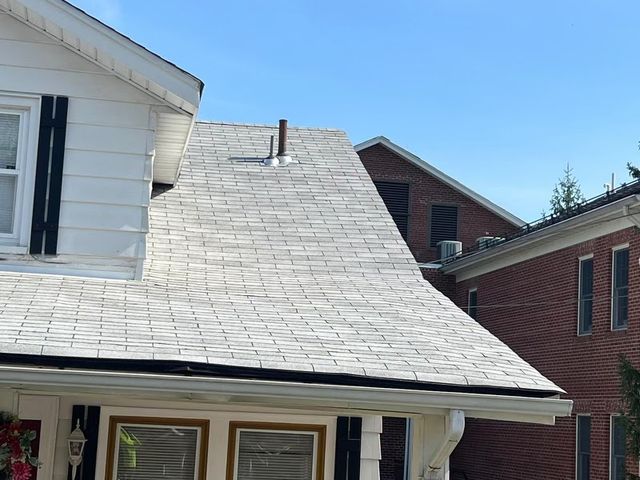
- Roof vents. Box vents, turbine vents, older ridge vents without external baffles and gable-end louvers can all let in rain or snow when wind hits them head-on.
- Pipe boots. The rubber collar around plumbing vents cracks after 10 to 15 years in the sun. A small split may stay dry in light rain but leak when water is blown against it.
- Unsealed or lifted shingles. Shingles rely on a factory adhesive strip to bond to the course below. If that seal never set properly or has broken from age or a previous storm, wind can lift the tab and drive water underneath.
- Rake edges. Along the sloped gable edges, poorly secured shingles or missing drip edge can let wind-blown water curl back onto the roof deck and fascia.
- Low-slope sections. Porch roofs, additions and shed dormers with a pitch under 4:12 drain slowly, so wind has more time to push water under the shingles, especially if they were installed without enough underlayment protection.
Is It Really the Roof?
Not every storm leak comes from the shingles. Wind-driven rain also gets in through window frames, siding gaps, deteriorated trim and even dryer or bathroom exhaust vents on the side of the house. If the water appears near the top of a window or along an exterior wall below a roofline, the siding or window flashing may be the real culprit.
It is also worth ruling out condensation. Moisture that forms in a cold attic can drip and look a lot like a leak. Our guide to telling attic condensation from a roof leak walks through the differences, but the short version is this: a wind-driven leak follows storms, while condensation shows up on cold, dry days.
How to Narrow Down the Source
You can gather useful clues before a roofer ever climbs a ladder. Do not go on the roof yourself, especially when it is wet or windy. Instead, try these steps from the ground and the attic:
- Note the wind direction. Check a weather app for the storm that caused the leak. Nor'easters typically blow from the northeast; summer thunderstorms often come from the west or southwest. The leak is usually on the side facing the wind.
- Mark the stain. Take a photo and measure its distance from the nearest exterior wall. This helps match the interior spot to what is above it.
- Check the attic during or right after a storm. With a flashlight, look for wet wood, drips on insulation or water trails along rafters. Water often runs along framing, so the entry point can be several feet uphill from the stain.
- Look at what is above the leak. Is there a vent, a pipe, a chimney, a dormer wall or a skylight in that area? That is your most likely suspect.
- Scan from the ground with binoculars. Look for lifted or missing shingles, a cracked pipe boot, bent vent covers or gaps at wall flashing.
A professional may also do a controlled water test, spraying one section at a time with a hose while someone watches from the attic. It takes patience, but it is often the only way to confirm a leak that only happens in specific conditions.
Typical Repairs and What They Cost in NJ
Most wind-driven leaks are fixed with targeted work rather than a new roof. Prices vary by roof size, pitch, access, material and the condition of the surrounding shingles, but these are common ranges we see for New Jersey homes:
- Pipe boot replacement: roughly $200 to $450 per boot.
- Resealing or replacing lifted shingles: about $250 to $700 for a small area.
- Adding kickout flashing: around $200 to $500 per location, more if siding has to be removed and replaced.
- Step flashing repair along a wall or dormer: often $500 to $1,500, depending on length and whether siding needs to come off.
- Chimney reflashing: commonly $600 to $1,800 depending on chimney size and masonry condition.
- Swapping old vents for wind-rated or baffled ridge vent: typically $400 to $1,200 depending on the length of the ridge.
If the roof is near the end of its life, has widespread unsealed shingles or keeps leaking in new places after each storm, a replacement may be the smarter spend. A good roofer will tell you honestly which situation you are in. You can learn more about our approach on the roof repair page.
How to Prevent Wind-Driven Leaks on a New Roof
If you are replacing your roof, a few details make a big difference against New Jersey storms:
- Shingles nailed in the manufacturer's nailing zone, with six nails per shingle in high-wind areas.
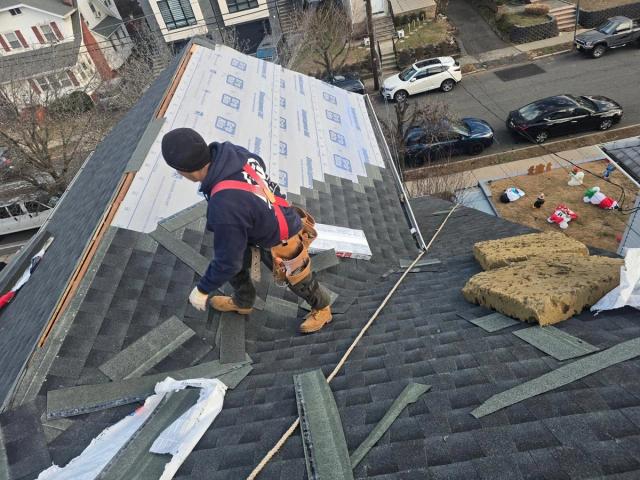
- Ice and water shield at eaves, valleys, around penetrations and on low-slope sections.
- New step flashing and kickout flashing rather than reusing old metal.
- Ridge vent with an external baffle designed to resist wind-driven rain and snow.
- Drip edge along eaves and rakes, plus starter strip shingles with adhesive at the edges.
As a GAF Master Elite® contractor, American Roofing Pros installs complete roofing systems to these standards, which is also what qualifies homeowners for GAF's stronger warranty coverage.
Next Steps
A leak that only shows up in wind-driven rain will not fix itself, and each storm gives water another chance to soak insulation, rot decking or stain ceilings. With nor'easter season underway, now is the time to track it down.
Call American Roofing Pros at (877) 228-1042 or request a free estimate. We will inspect the roof, show you photos of what we find and give you a written, itemized price for the repair.