A professional flat roof repair project begins with understanding the actual condition of the roofing system. Surface deterioration, damaged seams, aging materials, flashing problems, roof penetrations, and drainage concerns can all affect how a low-slope roof performs over time.
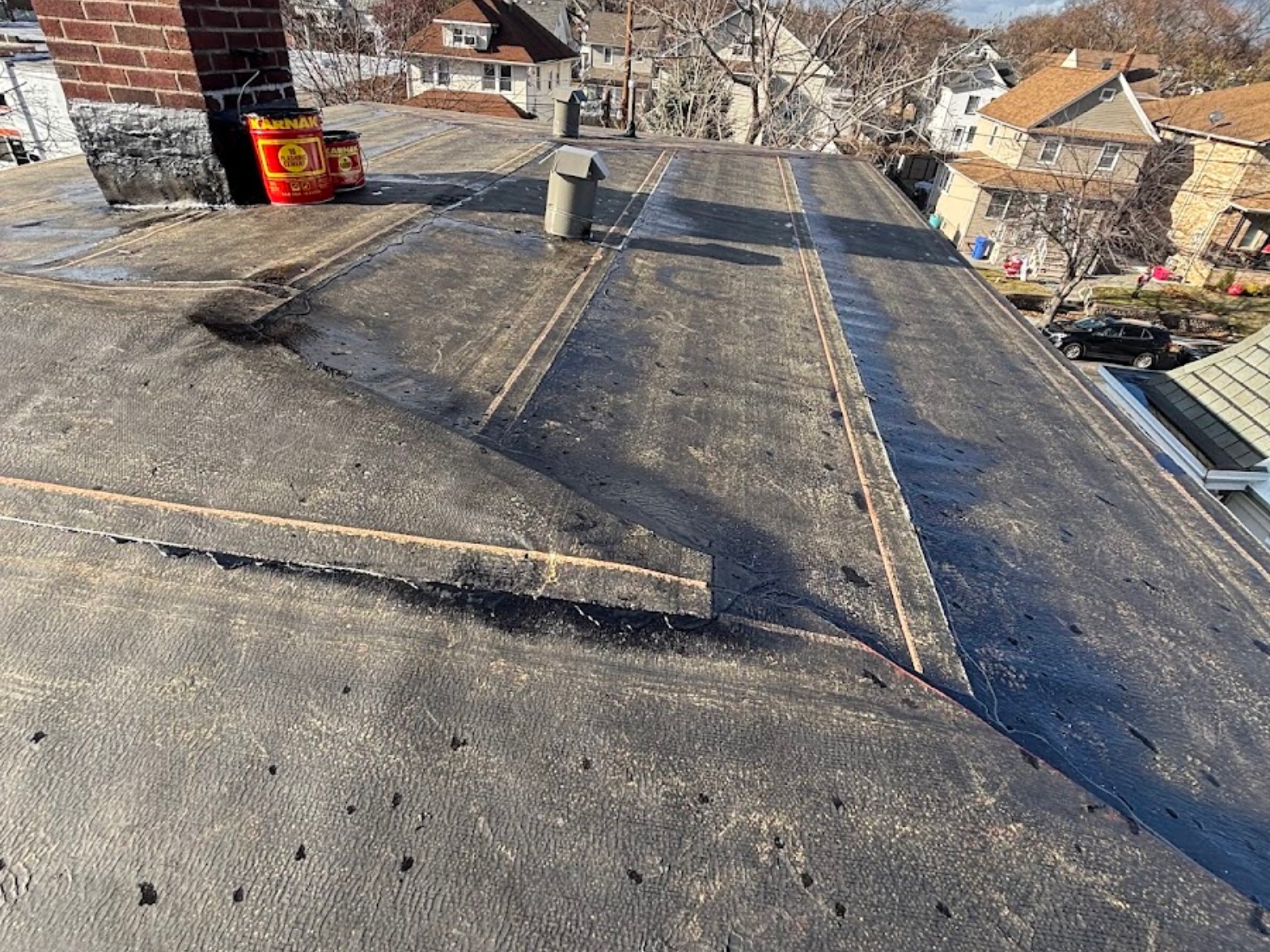
The featured photograph provides a detailed look at an older low-slope roofing system. The surface shows visible weathering, multiple seams, areas of deterioration, and transitions around roof penetrations. A chimney is also present, creating another important connection between the roofing system and the structure.
This type of roof requires more than a quick visual assessment from the ground. A professional evaluation should consider the entire roofing surface, including seams, edges, penetrations, flashing, drainage pathways, and the condition of the materials beneath the visible surface.
At American Roof Repair & Replacement, the company provides roof repair, roof replacement, roof leak repair, emergency roofing, roof damage repair, roof installation, and roof inspections. Its published roofing process includes inspection and estimate, professional installation, and final cleanup and inspection.
The objective of this project is not simply to improve the appearance of an aging roof. Proper roofing work is about restoring the integrity of the system and addressing the details that can contribute to moisture intrusion and continuing deterioration.
Understanding Flat Roof Repair
A low-slope roofing system has different requirements from a conventional steep-slope shingle roof.
Because the roof has relatively limited pitch, proper water management becomes especially important. Roofing professionals need to consider how water moves across the surface, where drainage occurs, and whether seams, penetrations, flashing, or other components show signs of deterioration.
According to the National Roofing Contractors Association, roof maintenance and repair programs are important parts of managing low-slope roofing systems, and professional inspection can include evaluation of roof slope, drainage, roof decks, insulation, and flashings.
The purpose of flat roof repair is therefore not simply to cover a visible defect. The repair process should begin by identifying the condition that caused the problem and understanding how the affected area connects to the surrounding roofing system.
That approach is particularly important when the roof contains multiple seams and penetrations like the one shown in the project photograph.
What the Photograph Reveals
The photograph shows an older low-slope roof with extensive surface weathering.
Several long seams are visible across the roofing surface. There are also areas where the roofing material appears uneven, worn, lifted, or patched. A chimney penetrates the roof near one side, while another roof penetration is located closer to the center.
These details are important because roofing failures do not always originate in the middle of a large open roof area.
Instead, vulnerable areas can include seams, changes in direction, flashing details, roof penetrations, edges, and locations where different sections of the roofing system meet.
The image does not by itself establish whether there is an active leak or determine the exact cause of deterioration. That requires an on-site professional inspection.
What the photograph does show clearly is that the roofing system has visible signs of age and surface wear that justify closer evaluation.
Why Low-Slope Roofs Require Detailed Inspection
A low-slope roof needs to manage moisture efficiently across a relatively shallow surface.
For this reason, inspection should extend beyond the most obvious visible defect.
A professional flat roof repair assessment can include checking the general condition of the surface, seams, flashing, penetrations, drainage areas, edges, and transitions.
The NRCA notes that accepted approaches to investigating roof leaks on low-slope roofs involve thorough examination to verify leakage paths and determine what is actually required to stop water entry.
That principle is especially relevant when a roof contains multiple layers of previous repair work.
A visible patch may indicate where someone attempted to address a problem, but it does not necessarily reveal the original source of moisture.
Professional inspection helps connect the visible condition with the underlying roofing system.
Evaluating Seams and Roofing Transitions
The seams visible in the photograph are among the most important details to examine.
Low-slope roofing systems commonly contain long membrane or material transitions that must remain properly sealed and integrated over time.
Weather exposure, aging, movement, previous repairs, and installation conditions can contribute to deterioration around these areas.
Professional flat roof repair should therefore include close attention to seams rather than treating each visible problem as an isolated defect.
GAF’s technical information for asphaltic low-slope roof restoration also emphasizes substrate preparation and detailing of seams, flashings, and penetrations before coating or restoration work.
This illustrates an important concept: the success of a roofing repair depends heavily on the preparation and detailing performed before the final repair material is applied.
A strong repair is built on understanding the existing roofing system.
Inspecting Roof Penetrations and Chimney Connections
The chimney visible in the photograph creates another important inspection point.
Any structure or component that passes through a roof interrupts the continuity of the roofing surface. That makes the surrounding flashing and transition details particularly important.
Professional roofing technicians need to evaluate the area where the roof meets the chimney, including the condition of the surrounding materials and visible flashing.
The same principle applies to other roof penetrations such as vents, pipes, drains, and equipment.
GAF’s low-slope roofing guidance specifically addresses careful treatment of roof penetrations and flashing because these areas can require specialized detailing within the roofing assembly.
During flat roof repair, these transition points should be inspected as part of the entire system rather than ignored because the larger roof surface appears relatively intact.
Surface Preparation Before Flat Roof Repair
Proper preparation is one of the most important parts of any roofing repair.
Before repair materials are applied, the existing surface may need to be cleaned, evaluated, and prepared so the new materials can properly bond or integrate with the existing system.
The exact preparation depends on the roofing material, the extent of damage, weather conditions, and the repair method being used.
For example, GAF’s restoration guidance identifies substrate preparation and detailed treatment of seams, flashings, penetrations, and damaged areas as stages that should be addressed before the final coating application.
The same principle applies more broadly to flat roof repair.
A repair applied over dirt, loose material, deteriorated substrate, or an unresolved moisture problem may not address the real condition.
Professional preparation helps create a more controlled foundation for the repair work.
Repairing Damaged Roofing Areas
Once the condition has been assessed and the surface properly prepared, the roofing professional can determine which areas require repair.
Depending on the roofing system, repair work may involve sealing or restoring seams, addressing damaged sections, repairing flashing, replacing deteriorated components, or restoring areas around penetrations.
The exact repair method should be selected according to the roofing assembly rather than applying the same technique to every roof.
This is why professional flat roof repair is a project-specific service.
The photograph illustrates that point well. The roof contains different sections with visible variations in wear and several construction details that require individual attention.
A qualified roofing professional can evaluate each area and determine whether localized repair is appropriate or whether more extensive work should be considered.
When Flat Roof Repair May Not Be Enough
Not every aging roof needs complete replacement.
A localized problem can sometimes be addressed through targeted repair when the surrounding roofing system remains serviceable.
However, extensive deterioration can change the situation.
Factors that may influence whether flat roof repair or a broader replacement should be considered include the age of the roofing system, the extent of visible deterioration, recurring leaks, previous repairs, damaged seams, moisture concerns, drainage performance, and the condition of the substrate.
American Roofing Pros NJ publishes both roof repair and roof replacement services, and its website describes inspection and estimate as the first step in its roofing process.
That means the decision does not need to be based solely on what is visible in a single photograph.
An on-site inspection can provide a more complete picture.
Flat Roof Repair and Water Management
Water management is a critical part of any low-slope roofing project.
Because water moves more slowly on a low-slope surface than on a steep roof, drainage pathways and roof geometry deserve close attention.
A professional inspection can look for areas where water may remain on the surface, deteriorated drainage components, blocked pathways, or other conditions that could contribute to prolonged moisture exposure.
NRCA materials emphasize the role of slope and drainage in low-slope roof performance and maintenance.
The photograph does not provide enough information to determine whether ponding water is occurring at this particular property. However, the low-slope configuration makes drainage an appropriate part of a professional evaluation.
Effective flat roof repair should therefore address the surrounding roofing conditions rather than focusing only on one visible patch.
Professional Materials and Installation
The materials selected for a roofing project should be appropriate for the existing system and the specific repair or replacement strategy.
Low-slope roofing can include different types of membranes and roofing assemblies, each with its own installation requirements.
The National Roofing Contractors Association identifies built-up roofing, polymer-modified bitumen, EPDM, TPO, and other low-slope systems within its roofing education and repair resources.
This variety reinforces why roofing professionals need to identify the existing system before choosing a repair method.
The correct material alone does not guarantee a successful flat roof repair.
Preparation, installation technique, compatible components, proper detailing, and final inspection all contribute to the quality of the finished work.
The Importance of Regular Roof Inspections
Regular professional inspections can help identify deterioration before it becomes more extensive.
This is particularly relevant for aging low-slope roofing systems, where a small seam problem or penetration detail may become more significant if moisture enters the roofing assembly.
NRCA guidance recommends scheduled inspection and maintenance programs as a way of helping building owners manage low-slope roof performance.
A professional inspection can document visible wear and help property owners understand what conditions require attention.
It can also provide useful information when deciding whether maintenance, flat roof repair, restoration, or complete replacement should be investigated.
Routine evaluation is therefore part of responsible roof management, not simply a response to an emergency.
Professional Workmanship From American Roofing Pros
American Roofing Pros NJ publishes a broad range of roofing services, including roof repair, roof replacement, roof installation, roof leak repair, emergency roofing, roof damage repair, and free roof inspections. Its website also describes a process built around inspection and estimating, professional installation, and final cleanup and inspection.
That approach is particularly relevant to projects involving older roofing systems.
A professional roofing service should begin by understanding the condition of the existing roof rather than assuming that every problem can be solved using the same repair method.
The company also publishes roofing work involving flat roof systems and describes solutions for both residential and commercial properties.
For property owners reviewing the condition shown in this photograph, the appropriate starting point is an inspection that can identify visible deterioration and determine the next practical step.
What Homeowners Should Expect During a Roofing Project
A professional roofing project should be organized around clear stages.
The first stage is typically inspection and evaluation.
The roofing professional reviews the visible roof condition, identifies areas of concern, examines details around penetrations and transitions, and determines whether additional investigation is necessary.
Next comes the recommendation.
Depending on the condition of the system, the recommended solution may involve localized flat roof repair, maintenance, restoration, or replacement.
The work itself should then follow the appropriate preparation and installation procedures for the specific roofing system.
Finally, the completed work should be reviewed and the property cleaned.
American Roofing Pros NJ describes its own roofing workflow as inspection and estimate, installation, and final cleanup and satisfaction check.
This process helps create a more predictable experience for homeowners and property owners.
A Closer Look at the Project Photograph
The uploaded photograph tells an important roofing story.
The surface has a visibly aged appearance, while several seams run across the roof. There are areas where roofing material appears worn or uneven, and the chimney creates a major roof-to-structure transition.
These details are exactly the type of features that deserve attention during a professional assessment.
Instead of looking at the roof as one large surface, an experienced roofing professional considers how all of the individual components interact.
The seams must be evaluated.
The chimney transition must be evaluated.
Roof penetrations need attention.
Drainage should be considered.
The general surface condition must also be reviewed.
That comprehensive approach allows flat roof repair to be based on the actual condition of the system rather than on assumptions.
The photograph should therefore be viewed as a useful project-condition reference, not as a substitute for an on-site inspection.
Final Inspection and Maintenance
Completing the repair is not the final step.
Once roofing work has been performed, the finished area should be inspected for proper installation, secure transitions, clean detailing, and completion of the intended repair.
The surrounding roof should also be reviewed to determine whether other conditions require attention.
This final inspection is valuable because roofing systems are interconnected.
Repairing one seam does not eliminate the need to evaluate nearby seams.
Restoring one penetration does not remove the importance of checking other penetrations.
A professional flat roof repair project should therefore conclude with a broader review of the repaired area and surrounding roofing conditions.
Ongoing maintenance can then help the property owner monitor the system and respond to future concerns before they become more extensive.
Conclusion
A professional flat roof repair project begins with inspection and ends with more than a visible patch.
It requires a detailed understanding of the roofing system, careful evaluation of seams and transitions, attention to chimneys and penetrations, proper surface preparation, compatible repair materials, accurate installation, and final inspection.
The featured photograph provides a useful example of why this process matters. The visible aging, seams, patches, and roof penetrations demonstrate how an older low-slope roof can contain several areas that deserve professional attention.
Not every roof with visible wear requires complete replacement, and not every roofing problem can be solved with a localized repair. The correct approach depends on the actual condition of the roofing assembly.
A professional inspection can help determine whether maintenance, flat roof repair, restoration, or a complete roof replacement should be considered.
American Roofing Pros NJ offers roof repair, roof replacement, roof leak repair, emergency roofing, roof damage repair, roof installation, and inspection services.
For homeowners and property owners dealing with an aging low-slope roofing system, professional evaluation is an important first step toward understanding the condition of the roof and planning the appropriate work.