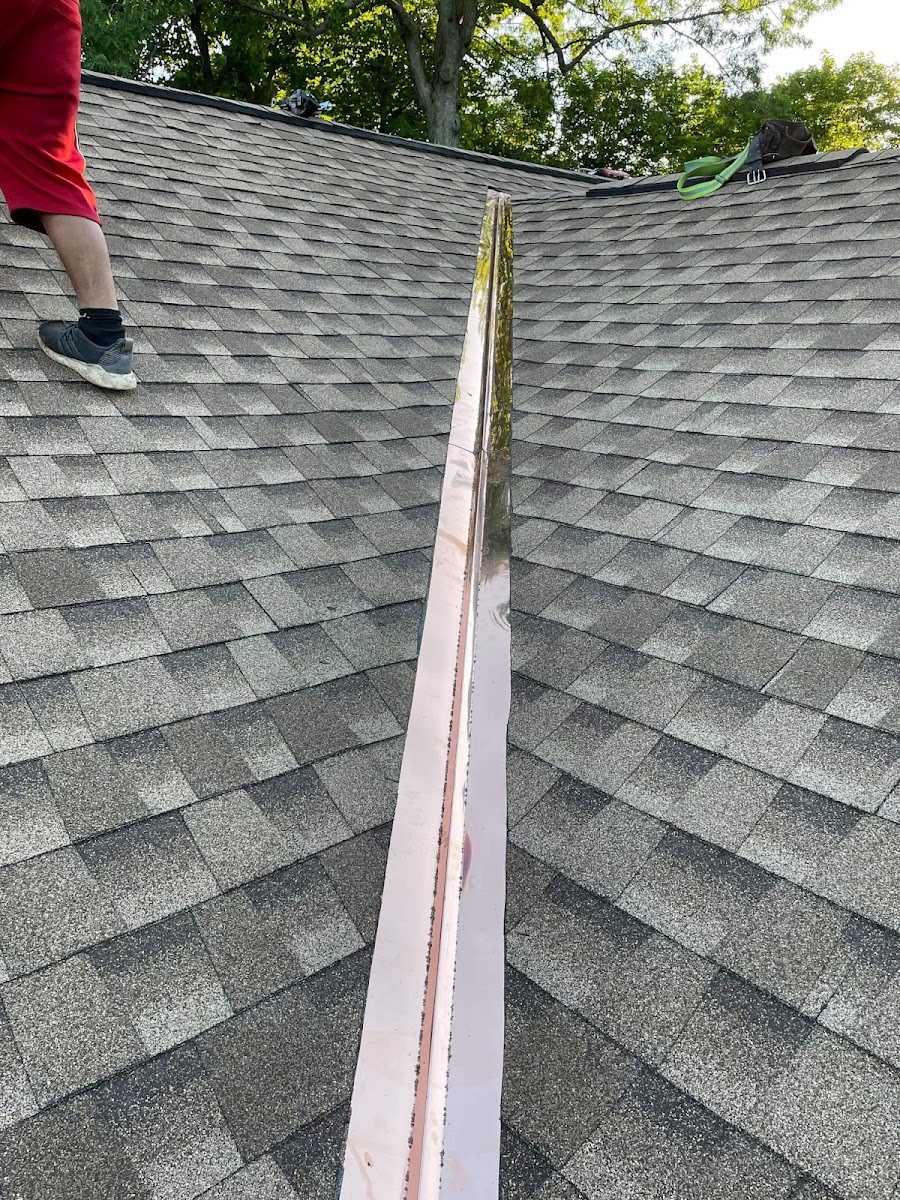
Copper valley flashing is the most durable, corrosion-resistant and dependable solution available for the area of a roof that endures the greatest stress: the valley. The photograph above shows a continuous copper channel installed where two roof slopes converge, with architectural asphalt shingles trimmed precisely along both edges. The installation is attractive, but its real value lies in function. This single detail determines whether a home remains dry through a nor’easter, a summer thunderstorm or a rapid winter thaw.
At American Roof Repair & Replacement, we install copper valley flashing on residential properties throughout New Jersey. Our inspectors regularly encounter the consequences of inferior valley work: corroded metal, failed seams, saturated underlayment, rotted decking and ceiling damage that appears years before it should. This guide explains what copper valley flashing is, why it outperforms other materials, how a professional installation is carried out, what influences the cost and how to decide whether it is the right choice for your home.
What Is Copper Valley Flashing and Why Does It Matter?
A roof valley is the internal angle formed where two sloping roof planes meet. Rainfall, snowmelt and debris from both slopes are directed into this single channel. As a result, a valley carries a far greater volume of water than any other part of the roof, and it carries that water at high velocity.
Flashing is the sheet metal that lines the valley and guides water safely to the gutter. Copper valley flashing is manufactured from solid copper sheet, most commonly 16-ounce material, which is approximately 0.0216 inches thick. This weight is widely accepted in the roofing industry as the standard for residential flashing. Additional technical information on the properties of the metal is available from the Copper Development Association.
The valley in the photograph is an open metal valley. The copper runs continuously down the centerline, the shingles are cut back evenly on each side and a raised rib at the center prevents fast-moving water from crossing the valley and driving beneath the shingles on the opposite slope. Details of this kind distinguish professional workmanship from rushed work.
Copper deserves careful consideration for three reasons:
- Valleys are among the most common points of failure. On most leaking roofs we inspect, the source is a valley, a chimney junction or a wall transition.
- Valleys are difficult to repair. Once covered by shingles, correcting a valley requires removing sections of the roof covering.
- Valleys influence the service life of the entire roof. A shingle system may last 20 to 30 years, yet weak flashing can compromise it in half that time.
Specifying copper valley flashing at the outset is considerably less expensive than repairing water damage later.
7 Benefits of Copper Valley Flashing
1. Copper Valley Flashing Delivers Exceptional Longevity
The strongest argument for copper is its service life. Correctly installed copper commonly performs for 50 to 100 years, and historic copper roofs and church domes have remained serviceable for even longer. Galvanized steel valleys frequently begin to corrode within 15 to 25 years, while painted aluminum can chalk, peel and deteriorate much sooner in humid or coastal environments.
Because copper typically outlasts the shingles around it, it can often remain in place when the roof covering is replaced in the future. That is a rare advantage in roofing, where most components are discarded at tear-off.
2. It Resists Rust and Corrosion
Copper does not rust. When exposed to air and moisture, it develops a thin, stable layer known as patina. This layer protects the underlying metal rather than consuming it. Over time, the bright, rose-gold finish visible in our photograph gradually darkens to a warm brown and eventually becomes a soft blue-green.
In New Jersey, where winter road salt, humid summers and heavy precipitation all affect building materials, this resistance is a significant advantage. Copper requires no paint or protective coating to remain watertight.
3. Copper Valley Flashing Manages Heavy Water Flow
Valleys concentrate runoff. Copper is smooth, strong and easily formed, which allows water to travel down the channel quickly without pooling or finding seams. Installers can shape copper into precise profiles, including a center rib or W-shaped configuration, that divides the flow and prevents overshoot at the edges.
4. It Tolerates Thermal Movement Without Cracking
New Jersey roofs experience wide temperature swings, from freezing January mornings to intense July afternoons. All metals expand and contract with these changes. Copper is ductile and flexible, so it accommodates this movement without splitting at seams, provided it is secured with appropriate cleats and fasteners that allow for expansion.
Lower-grade flashing materials can become brittle or distorted over time. Copper retains its form and its seal.
5. Copper Valley Flashing Enhances Curb Appeal
Many homeowners select copper for performance and are pleased by its appearance. The metallic line running down the roof in our photograph is both a protective element and a design feature. Copper complements gray, brown and black shingles, pairs well with stone and brick, and coordinates with copper gutters, chimney caps and roof vents.
As the metal ages, its changing color adds character.
6. It Reduces Long-Term Maintenance and Repair Costs
Copper requires virtually no maintenance. There is nothing to repaint, recoat or reseal on a regular schedule. Because it rarely fails, property owners avoid the recurring cycle of leak calls, patch repairs and interior restoration.
When costs are evaluated over 30 or 40 years rather than at the first invoice, copper is frequently the more economical option.
7. It Supports Property Value and Buyer Confidence
Home inspectors and prospective buyers recognize quality materials. Copper flashing signals that the roof was installed with care. Documented upgrades such as copper flashing, supported by a transferable workmanship warranty, strengthen buyer confidence and can improve your position at the time of sale.
Copper Valley Flashing vs. Other Valley Materials
Not every roof requires copper, so it is useful to understand the available alternatives.
Galvanized steel is common and inexpensive. It performs adequately for several decades when its zinc coating remains intact, but scratches, cut edges and standing water can lead to rust. It is a reasonable option on a limited budget.
Painted or mill-finish aluminum is lightweight and affordable. It is softer than copper, can dent during installation and may react with certain adjacent materials. It is acceptable for lower-budget projects but does not match copper for lifespan.
Closed-cut and woven valleys use shingles only, with no exposed metal. They can appear seamless, but water flows across multiple shingle layers, and the valley may wear faster in areas of heavy flow. Many professionals prefer an open metal valley on steep or complex roofs.
Copper valley flashing carries a higher initial cost than each of these alternatives. It also offers the longest service life, the best corrosion resistance and the most refined appearance. For homes where the roof represents a major investment, it is the premium specification.
One rule deserves particular attention: copper must be kept separate from aluminum and galvanized steel. When dissimilar metals are in contact in the presence of moisture, galvanic corrosion can damage the weaker metal. Copper runoff can also stain or corrode aluminum gutters below. A qualified installer plans the entire system so that all metals are compatible. Trade organizations such as the National Roofing Contractors Association (NRCA) publish detailed guidance on flashing design and metal compatibility.
How Copper Valley Flashing Is Installed
Installation quality is as important as the material itself. Even the finest metal will leak if it is set incorrectly. The following sequence reflects how our crews approach a copper valley installation.
Step 1: Remove existing roofing and evaluate the deck. The shingles and old flashing are removed from the valley area, and the plywood or board decking beneath is inspected. Any soft, stained or deteriorated sections are replaced before new materials are installed.
Step 2: Install waterproof underlayment. A self-adhering ice and water membrane is applied along the valley, extending well beyond the centerline on both sides. This layer serves as a secondary defense. If wind-driven rain or ice pushes water past the metal, the membrane prevents it from entering the home.
Step 3: Measure and form the copper. The metal is supplied in rolls and cut to length. On most residential roofs the valley metal is 16 to 24 inches wide, and wider on low-slope or high-flow sections. The installer forms a center rib or hem so that the water channel remains clearly defined, as seen in the raised center line running the full length of the valley in our photograph.
Step 4: Secure the metal with cleats. Copper is never nailed through the center of the channel, because each penetration creates a potential leak. Instead, copper or compatible cleats are fastened along the outer edges. These hold the metal firmly while permitting expansion and contraction.
Step 5: Cut and set the shingles. The shingles on both sides are trimmed in a straight line, leaving an even strip of exposed copper. A tapered cut at the top corner guides water into the channel rather than beneath the shingle edge. Shingle edges are bedded with a compatible roofing cement, applied sparingly.
Step 6: Inspect the completed valley. The installer verifies alignment, fastener placement, edge exposure and the transition at the base, where the valley meets the gutter or lower roof. The valley must discharge cleanly with no backup.
Common Copper Valley Flashing Mistakes to Avoid
Our team is frequently asked to inspect valleys installed by other contractors. The following errors are the most common.
- Nailing through the water channel. Exposed fastener heads are the most frequent leak point in any metal valley.
- Using metal that is too narrow. An undersized valley forces water up and beneath the shingles during heavy rainfall.
- Omitting underlayment. Metal alone is not a complete waterproofing system.
- Combining incompatible metals. Pairing copper with aluminum or galvanized components invites corrosion.
- Over-applying sealant. Heavy sealant cracks over time and traps moisture. Sound flashing relies on geometry and overlap, not caulk.
- Neglecting transitions. Where a valley meets another roof section or a wall, the flashing must be properly integrated with step flashing or a drip edge.
If a valley on your roof is currently leaking, a professional roof repair assessment will determine whether a minor correction is sufficient or whether the flashing requires replacement.
How Much Does Copper Valley Flashing Cost?
Pricing depends on valley length, roof pitch, site access and the weight of the copper. Copper costs noticeably more per linear foot than aluminum or galvanized steel, reflecting both the material and the skilled labor required to form and install it.
It is best understood as a one-time investment weighed against recurring repairs. A typical home has a limited number of valleys, so the added cost of copper represents a small share of a complete roof replacement, while the performance benefit is substantial. We recommend obtaining a written, itemized estimate that lists the flashing material, its weight and the underlayment separately, so that proposals can be compared fairly.
Before engaging any contractor, confirm that the company is properly registered. The New Jersey Division of Consumer Affairs allows homeowners to verify registration for home improvement contractors.
Maintaining Copper Valley Flashing
One of the principal advantages of copper is how little attention it requires.
- Inspect the roof twice a year, in spring and fall, and after major storms.
- Keep valleys clear of debris. Leaves, pine needles and branches can slow drainage and hold moisture against the metal.
- Manage nearby trees. As the photograph shows, mature trees often stand close to the home. Overhanging branches deposit debris in valleys, so periodic trimming is beneficial.
- Preserve the patina. The natural color change is protective. Harsh cleaners and wire brushes are unnecessary.
- Check shingle edges along the valley periodically for lifting or granule loss.
The shingles surrounding the valley must also remain in good condition. The Asphalt Roofing Manufacturers Association provides useful general information on shingle performance and care.
Why Homeowners Choose American Roof Repair & Replacement
Selecting a roofing contractor is as important as selecting the material. Clients who work with our team can expect:
- Experienced installers who treat flashing, valleys and details with the same care as the shingles.
- Clear, written estimates with no ambiguous line items.
- Quality materials matched to the home, budget and climate.
- A clean, organized job site and respect for the property.
- Candid advice. If standard flashing is sufficient for your roof, we will tell you. If copper is the better long-term investment, we will explain why.
Explore our roof repair services and roof replacement services to learn more, or contact our team to schedule an inspection.
Frequently Asked Questions About Copper Valley Flashing
How long does copper valley flashing last?
Copper can last 50 to 100 years when properly installed, often outlasting the surrounding shingles by several decades.
Is copper worth the additional cost?
For many homeowners, yes. The initial cost is higher, but copper reduces the risk of leaks, repairs and premature replacement. Over the full life of the roof, it is often the more economical choice.
Will copper change color?
Yes. Over time, copper naturally develops a patina, progressing from bright rose-gold to brown and, in some cases, to blue-green. The rate depends on weather, sun exposure and air quality. This layer protects the metal.
Can copper valley flashing be used with asphalt shingles?
Yes. It pairs well with architectural asphalt shingles, as shown in our photograph, as well as with slate, tile and metal roofing, provided dissimilar metals are kept apart.
Can I install copper valley flashing myself?
We strongly advise against it. The work requires precise forming, correct fastening and proper integration with underlayment and shingles. Errors can cause costly leaks, and working on a steep roof is hazardous. Engage a qualified professional.
Can it be added during a repair?
Often, yes, provided the surrounding roof is in good condition. The valley area must be opened and re-shingled. A professional inspection will confirm the most appropriate approach.
Is Copper Valley Flashing Right for Your Roof?
For a roof valley that lasts, resists corrosion, handles heavy water flow and enhances the appearance of the home, copper valley flashing is difficult to surpass. It is not the least expensive option, but it is among the most dependable. A roof is only as strong as its weakest detail, and the valley is where details matter most.
If you are planning a roof repair or replacement, or you have noticed leaks, stains or deteriorating flashing, the team at American Roof Repair & Replacement can inspect your roof and provide honest recommendations.